The Tamamushi Shrine: Buddhist Art in Asuka Japan
By Achyut Pachalla and Jeremy Paguibitan

The Tamamushi shrine or the Beetle shrine is a reference for understanding the construction of the Asuka period of Japan. Many relics that depicted Asuka period Japanese structures were often stored in wooden temples, most of which burned down in fires throughout the years, along with the wooden buildings they depicted. Due to that, the Tamamushi is especially unique in that is a relic of a bygone era in ancient Japan. The detail of the structure itself, being made with even the structural accouterments that one would expect in a shrine offers a clear look into everything from artistic influences to techniques utilized in its architecture. The Tamamushi shrine is a prime example of the cultural exchange facilitated by Buddhism as it adapted and picked up characteristics from the regions where it was practiced.
The patron of this shrine is unknown. The date of the Shrine’s construction is unknown. As Walley states, this resulted from not only a result from a lack of reliable documentation of this shrine (Figure 1) during this time but due also to the fact that there is “… the critical lack of seventh-century objects of this type…” (Walley, 270) for a comparison. What can be made sure though, is that it was made during the later Asuka Period during the seventh century. An argument made for this placing in time can be found in statues in Horyu-ji, the Yumedono (Guze) Cannon and Four Celestial Kings, with the shrine’s “… lavish filigreed bronze fittings on Tamamushi Shrine resembl[ing] similar decoration…” (Seiichi, 48) located on the statues. Furthermore, the statues were made in the “late Azuna Period” (Seiichi, 48), which lends to the idea of the shrine being built in that same period. However, we do know that this shrine was constructed in Japan, due to the materials used. The shrine is made out of camphor and cypress, which are “… native to Japan” (Seiichi, 40). The shrine’s name, Tamamushi, also refers to the iridescent wings of the tamamushi beetle that were used to decorate the shrine, which is another indicator of the shrine’s Japanese origin (Seiichi, 40).
The shrine exhibits both traditional Japanese styles along with Chinese and Buddhist influences, likely due to its construction in the Asuka Period, when Buddhism was coming into China. The shrine is about 232.7 centimeters tall, or 7.6 feet (Seiichi, 47). A little overview of the shrine is that it has a hip-and-gable roof, doors, rafters, and steps that lead up to the two-front door. The overall style of the shrine is said to be done in the style of “… an ancient palace-style…” (40). Furthermore, not only is it representative of ancient palaces, the shrine also gives valuable insight towards buildings of the early Asuka Period in Japan, due to the fact that “… early Asuka-period buildings were wooden and have…. been destroyed by fire” (40). The figures featured on the Tamamushi Shrine paintings, however, display influence from Chinese works, the side door panels displaying Chinese influenced bodhisattva portrayals from “… the Northern Qi (550-557) to the Sui (581-618) dynasty…” (Walley, 269-270) specifically. These bodhisattvas are clearly Chinese because of their ornate dress, relaxed figures, and the lotus flowers in their hands. Furthermore, the circular nature of the narratives presented is close to those “…on the walls of Chinese cave temples such as cave 254 at Dunhuang” (Mason, 47).

The purpose of this the Tamamushi Shrine is of course religious. The theme of charity is present is both the side panels, where it displays the Hungry Tigress Jataka (Figure 2), where a Bodhisattva, upon seeing the Hungry Tigress, throws himself off a cliff to their location, with “… [the] ravenous tigress and her cubs… devouring his flesh…” (Mizuno, 50). The other painting depicts the Buddha, this time as a Brahman, sacrificing himself to Indra after promising to if Indra completed a “stanza of scripture” (51). In the front panel, there is a depiction of the Compassionate Flowers Sutra, with the relics depicted being “… closely to the description of the relics performing ‘Buddha’s work’ in this sūtra” (Halley, 279). According to the sutra in question, these relics were supposed to be turned into a jewel, which will “produce miraculous phenomena… appeasing sentient beings and leading them to awakening” (Halley, 279). This relates to charity, as these relics offered are now being used to help people achieve enlightenment.

The panel on the back of the pedestal represents the story of the Buddha and the Dragon King (Figure 3), in which the Dragon King “…uses his wish-fulfilling jewel to provide gifts for other beings…” (318), that will show others how to gain enlightenment. Finally, the panel above the pedestal has monks being sheltered in pagodas on Vulture Peak, which represent the “Three Vehicles, as emphasized in the Compassionate Flowers Sūtra…” (318), which shows the charity of heavenly beings. With this focus on charity, one could say that the purpose of this shrine was to remind wealthy members of society how to help their communities through giving, and how charity allows one to attain enlightenment. Furthermore, the shrine represents a mountain, with the panel on the back having Mount Sumero, “… the mountain at the center at the universe… ” (Mason, 47) among other mountain iconography. It does so using Japanese architecture.
This shrine was only made possible by the cultural exchange Japan had with China and Korea during the Asuka Period (552-645 AD) when Buddhism started rising up in Japan. All the stories portrayed throughout the Shrine were likely imported from the Chinese dynasties of Sui, Wei, and Northern Qi, as mentioned above. The introduction of Buddhism in Japan itself was fostered by the Korean King of Paekche in 552 AD, who “sent a bronze statue of Buddha…” (Seiichi, 14) among other Buddhist goods. The various rulers succeeding him did not have a firm stance on Buddhism, as Shinto was considered the main religion, in Japan until Crown Prince Shotoku founded the Horyu-Ji temple near Nara (1) which eventually became one of the capitals of Japan. Due to its proximity to an important city, one can assume that Japan-style architecture was due to proximity, and also due to its location in a government-sponsored temple, and that its patrons were wealthy and powerful.
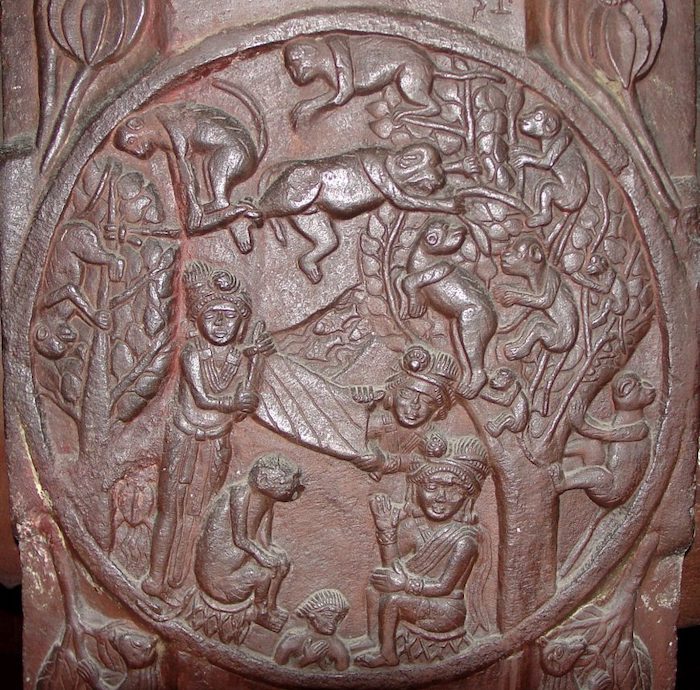
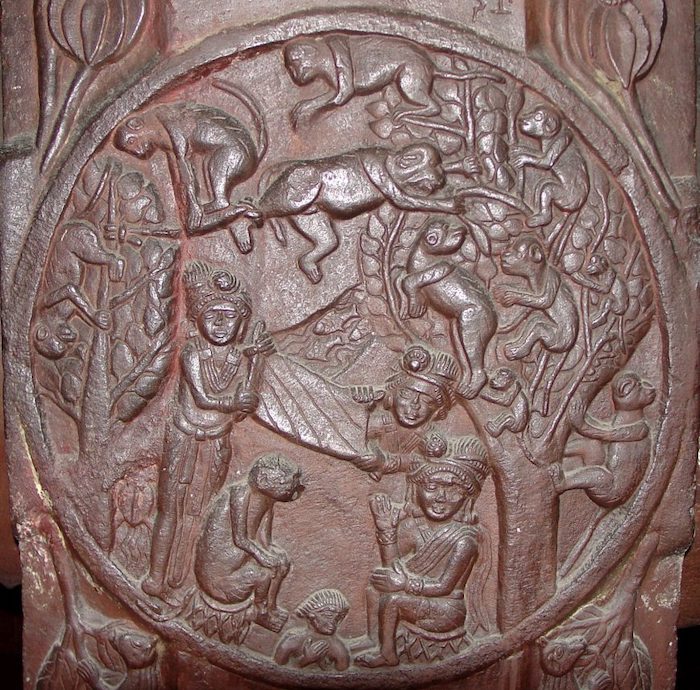
Although the shrine itself was heavily influenced by Korea and Chinese art, the Jatakas that are painted on with lacquer display a method of storytelling derived from India.”It is of special interest that a progression of time is shown, three separate event being illustrated in one picture, (These are the disrobing, the fall of the body, and its reception by the tigers.) This method of telling a story was imported from India.”(Hoshu 16). In the Bharhut Stupa in India the Mahakapi Jataka (Figure 4) is depicted in a roundel with multiple events in different points of time occurring in the same space. The full timeline of the story is compressed into a single spatial region. Given that the events of the story would be rather unclear to someone who hasn’t read the story the artist likely had a reasonable expectation that the jatakas were already known by the viewer. The same logic can also be applied to the Tamamushi Shrine as well, especially given that it was located in the Horyuji temple complex.
“As part of formal analysis, you’ll want to consider scale, or relative scale, both within the work and in relation to the viewer” (DeAlleva 27). The shrine is taller than most people at 7.6 feet (Seiichi 47). Although it is a miniaturization of a shrine it isn’t portable and is the size of something closer to furniture than a tabletop decoration. It is clearly meant to be admired given the painstaking effort of having to acquire the beetle wings for which the shrine is named, and perhaps to be circumambulated potentially being placed on a pedestal of sorts.
India, China, Korea, and eventually Japan, these were all the places that Buddhism traveled through to eventually culminate in the idea and creation of the Tamamushi shrine. An appropriate visual analogy for Buddhism might be a lint roller, as you roll it across the surface of an article of clothing it picks up the lint and the lint is added to the total mass of the lint roller itself. Buddhism, like all religions and cultural movements, is essentially like that lint roller, picking up influences and modifying itself as it rolls across the landscape. Its Japanese architecture along with its Chinese influences mark it as a representative of the Asuka period of Japan when Buddhism first encroached upon the island and led to cross-cultural inspired relics among which the Tamamushi shrine is one. It shares this characteristic with the other artifacts of the Horyu-ji Temple and could be interpreted as a window into a specific evolution of a culture. Technically, all cultures are in a constant state of evolution, as they are dynamic entities, this a result of the fact that cultures are defined by people who are in themselves also dynamic entities; hence, the necessity for both formal and contextual analysis when studying the significance of the Tamamushi shrine.
Words: 1510
Works Cited
Bharhut Stupa Roundel Jataka. Digital Image. Perseus Images. https://cdn.kastatic.org/ka-perseus-images/1240238d124ed244804529e50c607098df3acaf9.jpg
D’Alleva, Anne. Look!: The Fundamentals of Art History. Prentice Hall, 2010.
Hoshu Minamoto. An Illustrated History of Japanese Art. Translated by Harold Gould Henderson, K. Hoshino, 1935.
Mason, Penelope. History of Japanese Art. Abrams/New York, 1993.
Neighbor, Mary Parent. “Tamamushi No Zushi 玉虫厨子.” Japanese Art And Art Users System, http://www.aisf.or.jp/~jaanus/deta/t/tamamushinozushi.htm.
Seiichi Mizuno. Asuka Buddhist Art: Horyu-Ji. Translated by Richard L. Gage, vol. 4, Weatherhill/Heibonsha, 1974.
Walley, Akiko. “Flowers of Compassion: The Tamamushi Shrine and The Nature of Devotion in Seventh-Century Japan.” Artibus Asiae, vol. 72, no. 2, 2012, pp. 265–322. JSTOR, http://www.jstor.org/stable/24240761.
 Tamamushi Shrine
You guys did a good job capturing the different influences that were put into the artwork.
LikeLike
I enjoyed reading the descriptions of the art pieces. China and India influenced Japan a lot.
LikeLike
The work that you put into stating the importance of places such as this shrine in spreading and in the growth of Buddhism shows in this well done description of this artwork.
LikeLike
Very good job at explaining all the influences.
LikeLike
Really enjoyed how you had the picture of the entire shrine first, then separate sides of the shrine. The post was imformative. Well done.
LikeLike
Nice facts about describing the Tamamushi shrine.
LikeLike
enjoyed reading-super informative
LikeLike
Quotations from other sources are really good background and very informative.
LikeLike
I liked the fact that in your text you placed in parentheses which figure you were referring to. This allowed me to be able to read the text and look at the specific figure you are focusing on while also being able to go back to the text and following along.
LikeLike
The group did a very good job putting the information together; especially because many aspects are to be covered.
-Kevin Teas
LikeLike
I thought the influences were very interesting.
LikeLike
I really enjoyed the analysis of all the different parts of this piece and its influences.
LikeLike
very well written in text citations
LikeLike
I enjoyed the incorporation of influences and creating a tree art works that led to the target piece.
LikeLike
Each image was correctly labeled and it was easy to connect the information back to each image which I enjoyed. The description of the spread of Buddhism was very informative and the visual analogy was great 🙂 -Alondra Cruz
LikeLike
I liked how you included the citations of what picture you were talking about. That made it easier to follow.
LikeLike
A nice discussion of the different influences that resulted in the creation of the shrine. Nice incorporation of artwork to aid in the analysis.
LikeLike
I like how well you introduced the artwork and its background.
LikeLike
I like the integration of photos, and the beginning title. It was enticing, and the overall anaylsis made the artwork elevate as a whole.
LikeLike
Giovanny Graciano: I like the design and the layout of your blog post and I believe that it goes with the flow of what your blog post was about.
LikeLike
I liked the mix of formal analysis with historical context. It gave a very holistic view of the shrine.
Barin Asat
LikeLike
enjoyed the history of the shrine, and how its origins are largely unknown.
LikeLike
The background to your artwork was interesting. Well done.-Crystal Ramos
LikeLike
Very well written analysis.
LikeLike
This blog was very organized and informal which made it easy to read
LikeLike
The allocation of pictures next to their corresponding paragraphs was a nice touch.
LikeLike
Very fluent and informative.
LikeLike
I like that sources where included and so were quotes.
LikeLike
I really like how you guys explained connection between india and China
LikeLike
The information regarding the influences was very captivating.
LikeLike
I really enjoyed this blog. it was a very well written
LikeLike
Great use of descriptive words along with pictures!! It helps to understand what your describing when pictures are added!! Great stuff
LikeLike
Great use of descriptive words along with pictures!! It helps to understand what your describing when pictures are added!! Great stuff !!
LikeLike
Very thorough and in-depth analysis, but could have maybe been introduced stronger
LikeLike
I like how you included what the shrine also represents
LikeLike
Love the layout and pictures!
LikeLike